
The Myth: Optimism vs. Pessimism
Ask anyone on the street what “Murphy’s Law” means, and they will tell you it is about bad luck. It’s the toast landing butter-side down. It’s the rain starting just as you wash your car.
But ask a senior avionics engineer, and they will tell you the truth. Edward Murphy wasn’t a philosopher. He wasn’t a pessimist. He was a US Air Force Engineer. And his famous law wasn’t born in a kitchen; it was born at Edwards Air Force Base, during one of the most dangerous experiments in history.
The Origin: The Rocket Sled Experiment (1949)
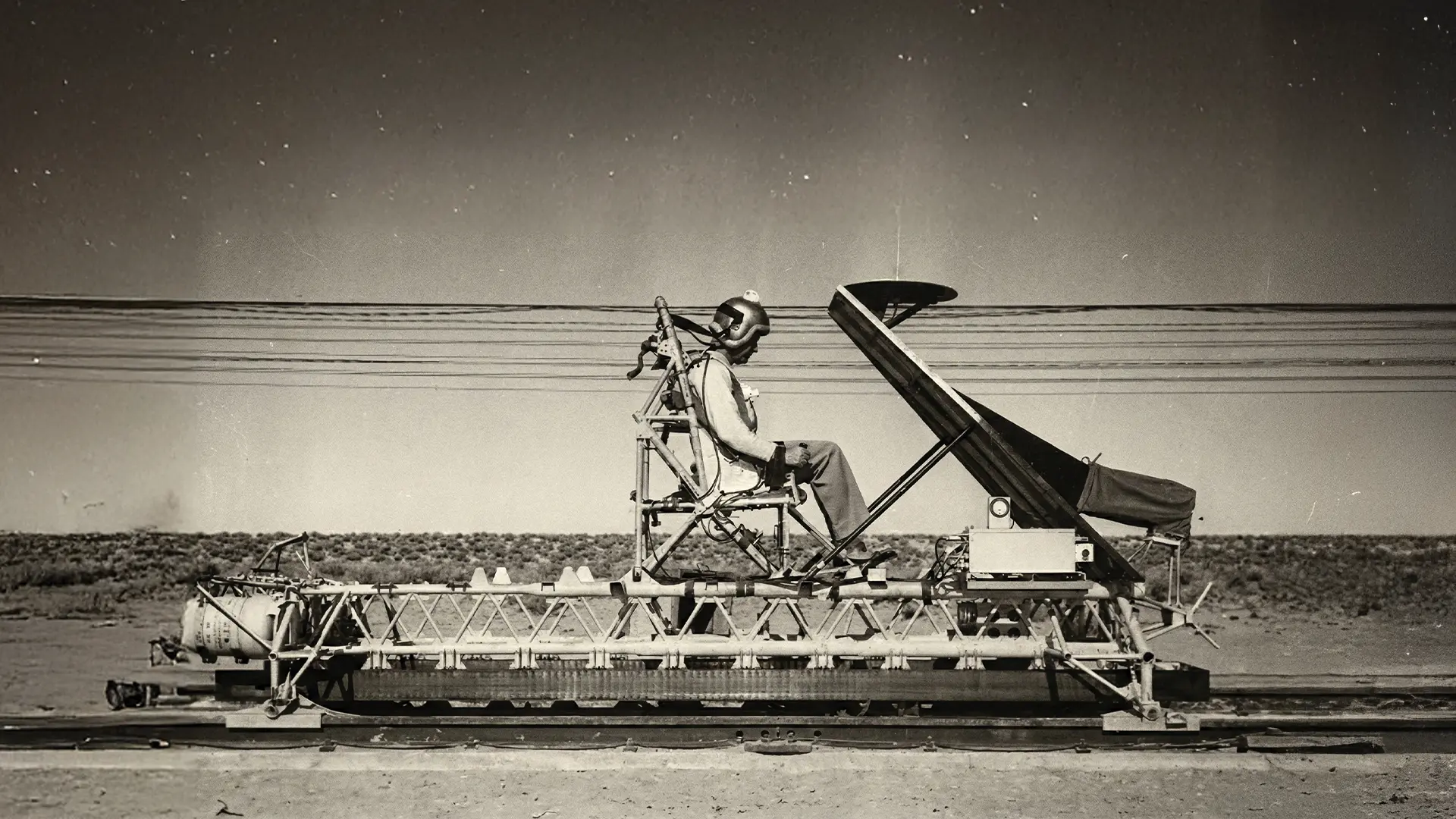
The mission was Project MX981. The goal: To find out how many Gs a human pilot could survive before dying. The vehicle: “Gee Whiz”. A metal coffin on rails armed with rockets producing 6,000 pounds of thrust.
Major John Paul Stapp, dubbed “The Fastest Man on Earth,” strapped himself into a rocket sled designed to accelerate to 600 mph and stop in 1.4 seconds. Murphy’s job was to design the sensors (strain gauges) that would measure the force on Stapp’s body.
The rocket fired. The sled stopped violently. Stapp’s eyes bled, bones cracked. He survived. But when Murphy checked the data, the sensors read Zero. Why? Because every single sensor had been wired backwards.

John Stapp during G force test, NASA
The Real Meaning: Design for the Inevitable
A furious Murphy reportedly said:
“If there are two ways to do a job, and one of them will result in disaster, he will do it that way.”
This wasn’t a curse. It was a realization of a fundamental engineering truth: Reliability relies on design, not on the operator.
This incident birthed the concept of “Defensive Design”. It is why circular military connectors have “Keyways” so they can’t be rotated. It is why we have “Poka-Yoke” (mistake-proofing).
The DEICO Perspective
At DEICO, we don’t design test systems assuming everything will go right. We design them assuming Murphy is watching. We label, we key, we shield, and we simulate the worst-case scenarios.
Because in our industry, Murphy’s Law isn’t a joke. It’s a safety regulation written in history. When you hear the “click” of a connector, remember John Stapp stepping off that rocket sled in 1949. That sound is engineering’s victory over chaos.